




Contact finger spring for conduction - inclined coil spring
Finger spring for conduction
Finger springs can be used as effective electrical conductors. There are application scenarios such as oscillations, dynamic conditions, and impact loads that can still provide reliable current conduction.
The situation that poses a challenge to transmission
Certain operating conditions may make it difficult to achieve a strong conductive connection. For example, oscillations and shock loads (such as those experienced in underground petrochemical occupations) can cause more traditional electrical connections to eventually loosen and jeopardize the integrity of signal and power transmission.
At any time, there is a high probability of motion, such as the connection of EV/HEV battery packs, and there is also a risk of damage to the electrical connection integrity. In the field of electrical engineering, performing high current applications such as conduction, grounding, and isolation may result in heating and reliability issues.
Rotating components, high temperatures, and load changes also pose challenges to maintaining electrical connections, and are common in wind energy applications involving turbines. In addition, there are similar issues with rotating components in robot end grippers and similar automation equipment.
In addition, lightweight planning methods are crucial for many applications, including unmanned vehicles that require lightweighting to maximize the expansion of battery constraints. And certain applications (such as semiconductor manufacturing) require solutions that can fulfill multiple purposes, such as conduction combined with latch/hold/confirm or EMI shielding.
Touch finger spring
Touch finger spring, also known as inclined coil spring or skewed coil spring, is generally used as a conductive spring to achieve high integrity connection as described earlier. However, there are several factors that make these springs different.
Firstly, they are able to maintain consistent force during large-scale deflection. Although the appearance is irregular, misaligned, the service has changed, and the scale has changed, the individual coils that make up these springs still adhere to the cooperative appearance. In addition, they have almost no permanent deformation due to compression, making them very suitable for irregular cross-sections.
When used as a conductive spring, a single coil serves as multiple touch points for conductivity and grounding; Essentially, each coil is a touchpoint. As long as a coil keeps touching the surface, it can maintain electrical connection.
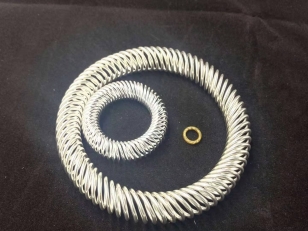
The conductive advantage of inclined coil spring
When a coil spring is used for conducting electricity, it has many advantages compared to more traditional methods. For example, in addition to being made from materials with high conductivity, helical springs can also be designed to meet specific electrical requirements. The changes in parameters such as spring diameter, wire diameter, coil height, skew angle, and turns make it possible to adjust amperage and resistance to optimize the solution. In addition, gold or silver coatings can also be used to achieve ultra-low impedance.
Due to the large surface area of skewed coil springs, they are able to transmit high power levels and generate less heat together than traditional solutions. Therefore, even at extremely high temperatures, they can provide excellent thermoelectric current carrying capacity. This same aspect is also important in implantable devices, and for the safety of patients, it is necessary to minimize the occurrence of heat as much as possible. In addition to its conductivity, helical springs can also serve as excellent EMI/RF shielding layers for downhole applications in oil exploration.
Skewed spiral springs support space, component, and power requirements, reducing system complexity together. In addition to conducting electricity, this system simplification is generally seen when they are used for mechanical fastening (locking, securing, or sticking). Compared to equivalent conductivity solutions, they can achieve greater touch density in a smaller space. As mentioned earlier, one of the outstanding features of coil springs is their ability to provide a specific level of force for fastening, including low force insertion.
As mentioned in the previous section, although there are factors such as impact and impact loads, viewpoint deviation oscillations, scale changes, and irregular cooperative surfaces, these springs are still able to maintain touch with the surface. In addition, they maintain their functionality under other harsh conditions through the use of corrosion-resistant materials and coatings. If planned and installed correctly, coil springs can reduce the likelihood of conductor fatigue failure associated with repeated insertion/removal cycles. Their minimal compression deformation also helps to extend their service life.
Finally, if needed for medical, pharmaceutical, food, and beverage applications, skewed coil springs are easy to clean and disinfect.
conclusion
Diagonal coil springs are used as highly reliable electrical conductors in professions such as medicine, transportation, aerospace, semiconductor manufacturing, industry, power, and defense. From surgical bone saws to guided weapons, coil springs provide a reliable and effective conductive solution.